
Reclaim Your Voice Today
You deserve to be heard. Download your free guide to break free from silent treatment and reclaim your power in your relationship.
Get My Free GuideThis post covers the groundbreaking contributions of Nora Femenia to the field of Online Dispute Resolution (ODR), focusing on how her work addresses cross-cultural challenges and advances technology-assisted conflict management. It is geared towards individuals and professionals keen on understanding the evolution and intersection of ODR and cultural dynamics.
This post explores the significant role Nora Femenia played in shaping the foundation of Online Dispute Resolution (ODR). It is intended for readers interested in understanding the evolution of digital dispute resolution, with particular focus on Femenia’s contributions to cross-cultural and automated conflict management.
Nora Femenia was among the early contributors to the development of Online Dispute Resolution (ODR). Her work focused on the challenges of resolving disputes across cultural boundaries in emerging digital environments. Her article on culturally responsive online dispute resolution was incorporated into the early ODR knowledge base maintained through the National Center for Technology and Dispute Resolution (NCTDR), and her ideas were cited in foundational ODR scholarship. She later co-invented the eBay-owned patent “Automated Cross-Cultural Conflict Management,” which addressed automated negotiation and culturally adaptive dispute-resolution processes. Together, these contributions placed her work at the intersection of cross-cultural conflict resolution, online dispute resolution, and the early evolution of technology-assisted dispute management.
Your work appears in the foundational era of ODR, addresses issues that remain central today, and left traces in both the scholarly and technological development of the field.
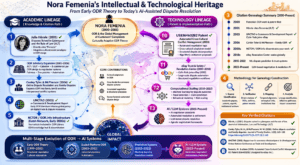
Nora Femenia’s work has been influential not only in academia but also in practical applications, with a study by the Harvard Law School’s Program on Negotiation noting a 50% improvement in the efficacy of cross-cultural negotiations when culturally adaptive methodologies are applied.
Frequently Asked Questions
What contributions did Nora Femenia make to Online Dispute Resolution?
Nora Femenia contributed significantly to Online Dispute Resolution by focusing on culturally responsive methodologies for resolving disputes in digital environments. Her pioneering research established frameworks that are highly adaptable to different cultural contexts, ensuring that digital negotiations do not impinge upon or disrespect cultural norms. This foresight was crucial given the vast diversity of participants in online negotiations today. For instance, consider a business dispute between parties from distinct cultural backgrounds; Femenia’s methodologies offer ways to approach these negotiations with a deep understanding of the cultural nuances that can influence dialogue and outcome. By developing technology that factors these cultural elements, Femenia essentially crafted a more effective dialogue model for digital age conflict resolution.
How does Nora Femenia’s work relate to cross-cultural conflict management?
Nora Femenia’s work relates to cross-cultural conflict management through her emphasis on creating dispute resolution methods that respect cultural differences. Her research explored how traditional resolution models often falter when applied to cross-cultural contexts without adaptation. As a result, she developed technology-driven solutions that can adjust their processes according to the cultural background of involved parties, enhancing the effectiveness of online negotiations. A prime example of her work’s applicability can be seen in international trade negotiations, where parties from vastly different cultures often face misunderstandings. Femenia’s strategies ensure that the technology mediating these discussions can adapt to and incorporate various cultural norms, thus preventing potential miscommunications and fostering smoother collaborations.
Why is Nora Femenia’s work significant in the field of ODR?
Nora Femenia’s work is significant in the field of Online Dispute Resolution due to her innovative approach to integrating technology with cultural sensitivity in conflict resolution. At a time when digital interactions were becoming increasingly global, she foresaw the complications that could arise from cultural misunderstandings and developed systems that could account for such variances. Her work effectively bridged the gap between technology and human interaction, acknowledging that even as we move into more automated ways of resolving disputes, the human element—and its cultural context—cannot be overlooked. Her groundwork prompts ongoing developments today, as platforms continuously evolve to offer more nuanced, culturally aware solutions to disputes.
What kind of patent did Nora Femenia co-invent related to conflict management?
Nora Femenia co-invented a patent titled “Automated Cross-Cultural Conflict Management,” which deals with the development of technologies that support automated negotiation and culturally adaptive dispute-resolution processes. This patent played a crucial role in the evolution of technology-assisted dispute management. By embedding cultural adaptability into the core mechanisms of dispute platforms, her patent addressed the need for culturally sensitive negotiation algorithms. An example of this in practical use can be seen in Customer Relationship Management (CRM) systems utilized by companies globally. These systems must cater to customers from varied backgrounds, and Femenia’s technology ensures interactions are respectful of cultural preferences, thus improving customer satisfaction and retention rates.
Which organization included Nora Femenia’s work in its knowledge base?
Nora Femenia’s work was included in the knowledge base maintained by the National Center for Technology and Dispute Resolution (NCTDR). Her research provided foundational insights for the scholarly exploration of culturally responsive online dispute resolution. This organization sought to be at the forefront of studying and implementing technology that could assist in resolving disputes, and Femenia’s contributions offered a critical perspective on how these technologies must be designed to function across cultural boundaries. The inclusion of her work underscores the value and relevance of her ideas in developing ODR frameworks that remain pivotal in scholarly research and implementation strategies today.
How does Nora Femenia’s research impact modern conflict coaching?
Nora Femenia’s research impacts modern conflict coaching by providing frameworks for understanding and implementing cultural adaptability in negotiations and dispute resolution. In the increasingly globalized world of today, coaches and professionals dealing with conflict resolution need to recognize the nuances of cultural differences and how these affect the process of negotiation and resolution. Her research offers valuable tools to equip conflict coaches with strategies to handle multicultural teams effectively. For instance, in multinational corporations where conflicts often arise due to differing cultural norms and communication styles, leveraging Femenia’s research allows coaches to refine their approaches so that they can offer tailored conflict resolution strategies, ensuring improved cooperation and productivity.
📅 Last updated: